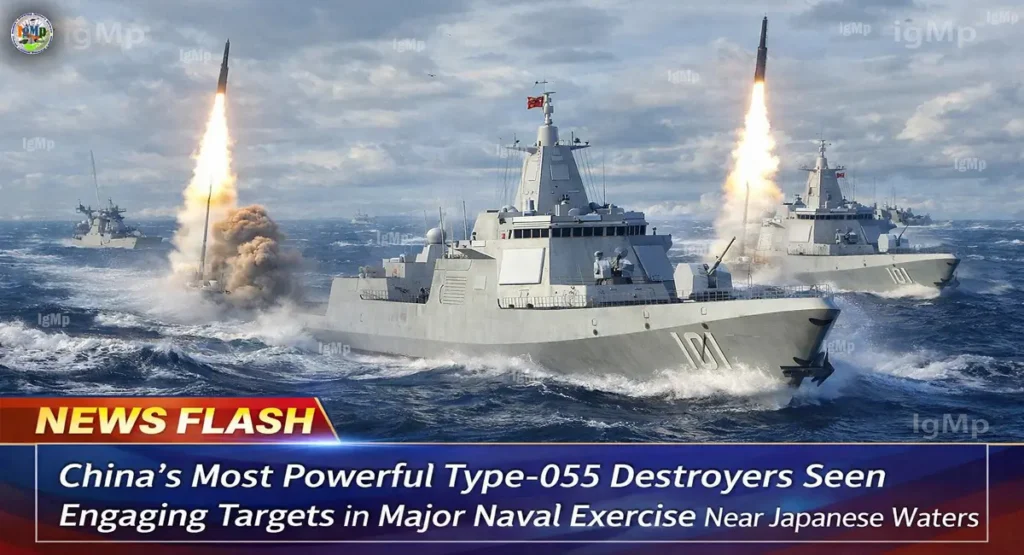
China’s newest and most powerful surface combatants, the Type-055 guided-missile destroyers, have been filmed conducting live-fire drills during a naval exercise conducted by the Eastern Theatre Command near Japanese waters. The footage, released by the People’s Liberation Army Navy (PLAN), showed the advanced warships engaging simulated targets while operating under what officials described as “complex electromagnetic conditions.”
The exercise featured the destroyers Anqing and Dongguan, two of the latest vessels to enter service in China’s rapidly expanding fleet. The ships are among the most heavily armed destroyers currently in operation anywhere in the world and play a central role in protecting China’s aircraft carrier strike groups.
As of March 2026, Anqing and Dongguan are the ninth and tenth Type-055 destroyers to enter service with the People’s Liberation Army Navy, highlighting the pace at which Beijing is expanding its blue-water naval capabilities.
The deployment also reflects the increasing importance of the Eastern Theatre Command, which oversees military operations in the East China Sea and areas surrounding Taiwan.
What Are the Capabilities of the Type-055 Destroyer?
The Type-055 destroyer, sometimes described by analysts as a cruiser-class warship due to its size and firepower, was designed to serve as the core air-defense and missile platform within Chinese naval task forces.
Key specifications include:
- Displacement: Approximately 13,000 tons
- Length: Around 180 meters
- Missile Launch Cells: 112 universal vertical launch system (VLS) cells
- Primary Radar: Type 346B active electronically scanned array (AESA) radar
- Primary Role: Fleet air defense, anti-ship warfare, and long-range strike
The 112 VLS cells allow the destroyer to launch a wide range of missiles, including long-range surface-to-air interceptors, anti-ship cruise missiles, and land-attack weapons.
This makes the Type-055 one of the most versatile surface combatants currently deployed by any navy.
All vessels are assigned to the Eastern Theatre Navy.
[🧵1/3] Anqing (110) is one of the latest Type 055 destroyers, commissioned in February 2026. There have been no reports from the JSDF on her activities in the vicinity of Japan. See also: https://t.co/VwfdvDVv99.— Song's Defence Watch🇦🇺🇯🇵 (@songs349) April 8, 2026
Why the Eastern Theatre Command Exercise Matters
The exercise conducted near Japanese waters highlights China’s focus on strengthening naval operations in the Indo-Pacific’s most strategically sensitive maritime corridors.
The Eastern Theatre Command is responsible for overseeing operations in the East China Sea and Taiwan Strait, regions that are central to the broader strategic competition between China and the United States and its allies.
By conducting advanced naval drills in this region, the PLAN is demonstrating its ability to deploy powerful surface combatants capable of defending carrier groups and maintaining maritime control during high-intensity operations.
Such exercises also signal Beijing’s intent to strengthen its presence in waters where U.S. and Japanese naval forces frequently operate.
Training in a “Complex Electromagnetic Environment”
One of the most notable aspects of the drill was the emphasis on operating under complex electromagnetic conditions.
In modern naval warfare, electronic warfare plays a critical role. Adversaries may attempt to jam radar systems, disrupt communications networks, or interfere with missile guidance systems during combat.
Training under these conditions ensures that crews can maintain combat effectiveness even when facing electronic interference or cyber-electromagnetic attacks.
For ships like the Type-055, which rely heavily on advanced radar systems such as the Type 346B AESA, the ability to operate in an electronically contested battlespace is essential.
How the Type-055 Compares With U.S. Destroyers
The Type-055 is frequently compared with advanced American warships such as the Zumwalt-class destroyer and the widely deployed Arleigh Burke-class destroyer.
While the Zumwalt features stealth shaping and experimental technologies, the Chinese design emphasizes high missile capacity and fleet air-defense capabilities.
The larger hull of the Type-055 also provides significant room for sensors, weapons, and future upgrades. In contrast, analysts often note that the long-serving Arleigh Burke design, first introduced in the early 1990s, offers more limited upgrade space due to its smaller hull dimensions.
This difference has become an important factor in discussions about the future balance of naval power in the Indo-Pacific.
Strengthening China’s Carrier Strike Groups
Ultimately, the primary role of the Type-055 is to provide a mobile missile shield for Chinese carrier groups and amphibious task forces.
With powerful radar systems, extensive missile batteries, and advanced electronic warfare capabilities, the destroyer serves as the central defensive node within China’s expanding blue-water fleet.
As more vessels of the class enter service, the Type-055 is expected to play an increasingly important role in shaping the regional naval power balance across the Indo-Pacific.