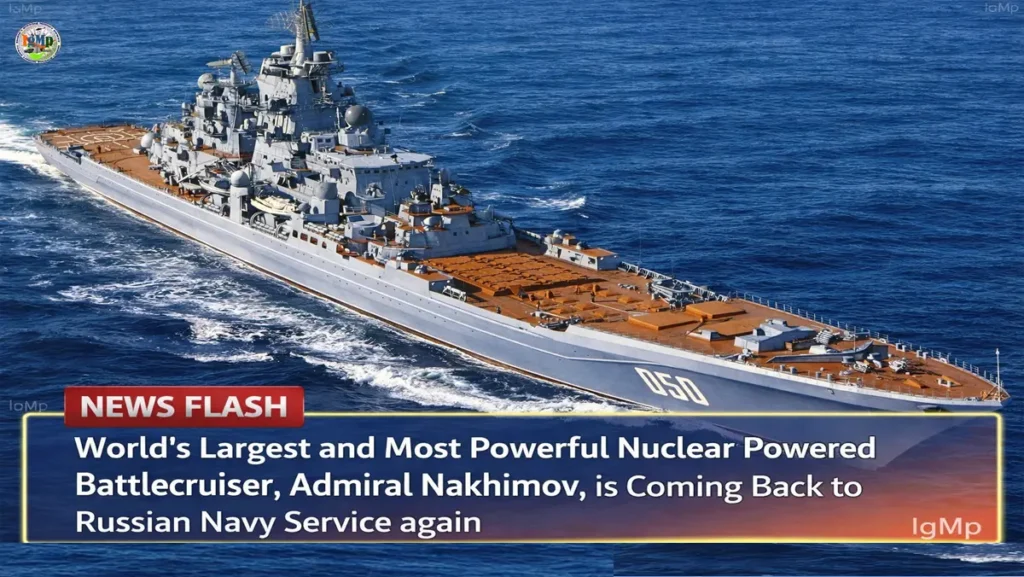
After nearly two decades of delays, redesigns, and spiraling costs, Russia’s nuclear-powered battlecruiser Admiral Nakhimov is finally approaching a decisive moment. The warship, once seen as a fading relic of Soviet naval ambition, is now undergoing critical sea trials in 2026. Its return marks one of the most ambitious naval modernization efforts in recent history, drawing global attention from defense analysts and naval strategists alike.
What makes this development particularly significant is not just the ship’s revival, but its transformation. Rather than restoring the vessel to its original Cold War configuration, Russia has effectively rebuilt it into a modern, missile-heavy platform designed for 21st-century warfare. In an era increasingly defined by hypersonic weapons, drones, and network-centric combat, Admiral Nakhimov is being positioned as a symbol of renewed naval firepower.
Admiral Nakhimov (Project 1144.2M) is a 28,000-ton nuclear-powered battlecruiser undergoing 2026 sea trials after deep modernization. It now features 176+ Vertical Launch System (VLS) cells, including hypersonic Zircon missiles, making it arguably the most heavily armed surface warship in the world.
From Soviet Giant to Modern Arsenal Ship
Originally commissioned as part of the Kirov-class during the Cold War, Admiral Nakhimov was designed to counter U.S. carrier strike groups through sheer firepower and nuclear endurance. However, its prolonged modernization has fundamentally changed its operational philosophy. Instead of functioning as a traditional missile cruiser, the ship has evolved into what many analysts now describe as a “floating arsenal ship”—a platform built to deliver overwhelming missile salvos across multiple domains.
This transformation reflects a broader shift in naval doctrine, where the emphasis is no longer on individual ship-to-ship engagements but on long-range precision strikes and layered defense. By upgrading an existing hull with cutting-edge systems, Russia has effectively leapfrogged decades of incremental design, turning a legacy platform into a strategic asset tailored for modern conflict environments.
The 3S14 VLS Integration
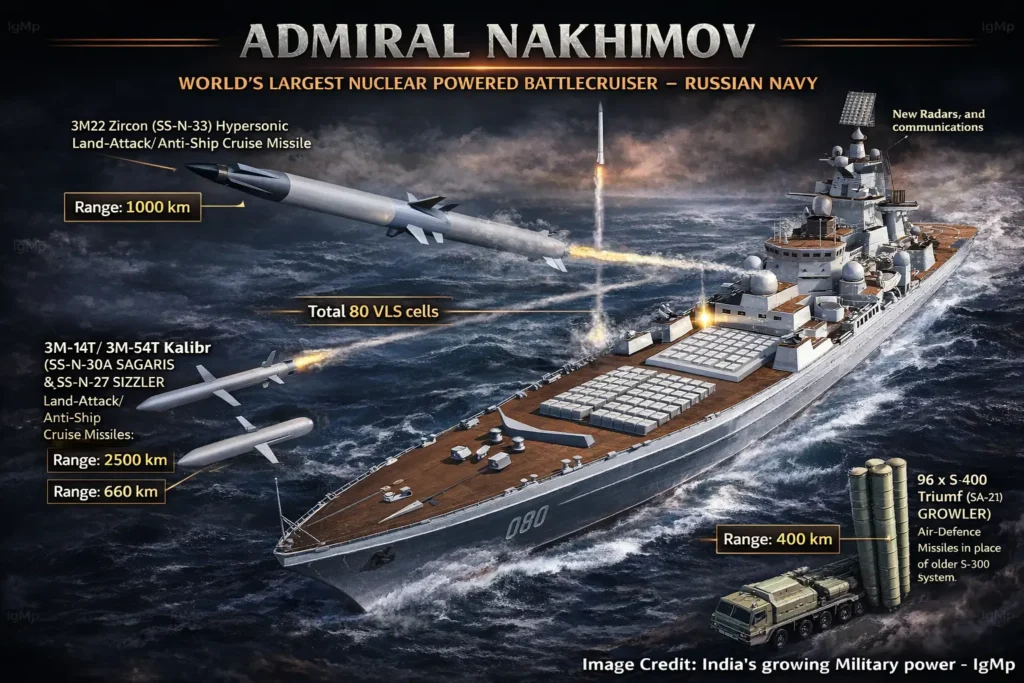
At the heart of this transformation lies the integration of the 3S14 vertical launch system, which replaces the ship’s massive and outdated P-700 Granit missile tubes. This change is more than a simple upgrade—it represents a complete overhaul of how the ship projects power. The new universal VLS cells allow Admiral Nakhimov to carry a diverse mix of advanced munitions, enabling it to adapt to different mission profiles without structural modification.
The ship now carries around 80 universal VLS cells capable of launching Zircon hypersonic missiles, Oniks supersonic anti-ship missiles, and Kalibr land-attack cruise missiles. Complementing this is an additional 96 dedicated air-defense cells, likely linked to navalized S-300FM or S-400 systems. Together, this brings the total missile capacity to over 176 cells, giving the ship an unparalleled ability to conduct simultaneous offensive and defensive operations at extended ranges.

Zircon vs. Carriers: A Strategic Threat
The inclusion of Zircon hypersonic missiles is arguably the most consequential aspect of the Nakhimov’s modernization. Unlike traditional cruise missiles, Zircon operates at extreme speeds—reportedly above Mach 8—while maintaining maneuverability, making interception exceedingly difficult for current naval air defense systems. This capability fundamentally alters the threat landscape for large naval formations.
For aircraft carriers, which rely heavily on layered defense and early warning systems, Zircon presents a unique challenge. Its speed drastically reduces reaction time, while its flight profile complicates tracking and interception. As a result, Admiral Nakhimov is no longer just a defensive escort or deterrent platform—it becomes a high-value offensive asset capable of holding critical naval targets at risk across vast distances.
How It Compares Globally
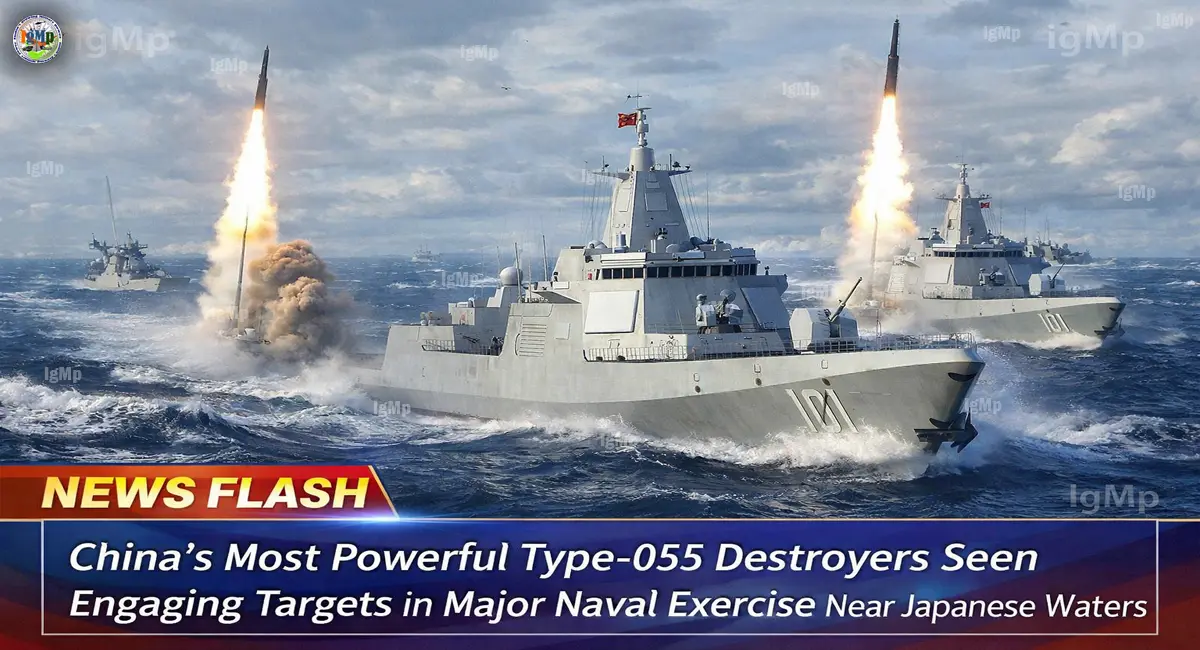
When compared to modern surface combatants, Admiral Nakhimov stands in a category of its own. Most contemporary destroyers, such as China’s Type 055 or the U.S. Navy’s Ticonderoga-class cruisers, balance firepower with versatility and fleet integration. In contrast, Nakhimov prioritizes sheer missile capacity and strategic impact, effectively functioning as a concentrated strike platform.
| Warship | Displacement | VLS Cells |
|---|---|---|
| Admiral Nakhimov | ~28,000 tons | 176+ |
| Type 055 (China) | ~13,000 tons | 112 |
| Ticonderoga-class (U.S.) | ~9,800 tons | 122 |
With a displacement of around 28,000 tons and over 176 VLS cells, it dwarfs its closest counterparts in both size and firepower. This comparison highlights a fundamental difference in naval philosophy: while other navies emphasize distributed lethality, Russia appears to be investing in high-density strike platforms capable of delivering overwhelming firepower from a single hull.
The Drone Threat: Can Pantsir-M Defend It?
Despite its formidable offensive capabilities, the survivability of such a large warship in the age of drones remains a critical concern. Recent conflicts have demonstrated how relatively low-cost unmanned systems—both aerial and surface—can pose serious threats to high-value naval assets. This has raised questions about whether ships like Admiral Nakhimov can effectively defend themselves in modern combat scenarios.
To address this, the vessel has been equipped with six Pantsir-M close-in weapon systems (CIWS). These systems combine rapid-fire autocannons with short-range missiles, creating a layered defensive shield against incoming threats. Designed specifically to counter drone swarms, precision-guided munitions, and low-flying targets, Pantsir-M significantly enhances the ship’s ability to survive in contested environments. Rather than being a vulnerable giant, Nakhimov is being refitted as a heavily defended missile fortress.

Why Russia Still Needs It
For Russia, the modernization of Admiral Nakhimov is as much about necessity as it is about capability. With limitations in shipbuilding capacity and delays in next-generation destroyer programs, upgrading existing platforms offers a practical way to maintain naval relevance. In this context, Nakhimov serves as a force multiplier, compensating for gaps in fleet size with concentrated firepower.
Its return also coincides with the expected retirement of its sister ship, Pyotr Velikiy, which has long served as the flagship of Russia’s Northern Fleet. This transition underscores the strategic importance of the Nakhimov program—not merely as an upgrade, but as a critical replacement in Russia’s surface combatant lineup.
As Admiral Nakhimov progresses through its 2026 sea trials, it represents a striking blend of old and new—Cold War engineering fused with modern missile technology. Its re-entry into service signals Russia’s continued focus on high-impact naval assets capable of challenging even the most advanced fleets.
Yet, its true significance lies in the broader question it raises for naval warfare: in an age dominated by drones, hypersonic weapons, and distributed systems, does the future belong to massive, heavily armed warships—or to smaller, more agile platforms? Admiral Nakhimov may soon provide the answer.