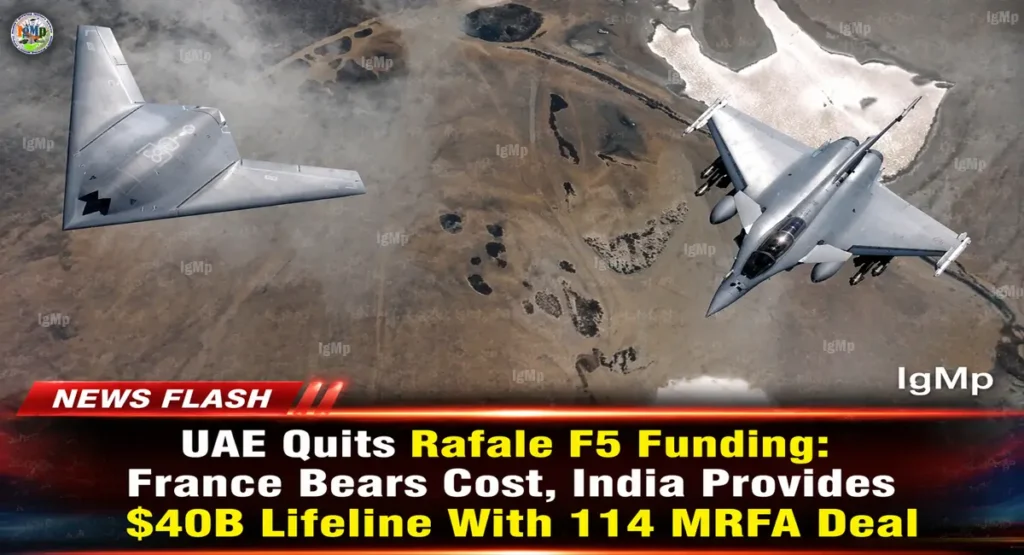
As per media reports, the UAE has officially decided to withdraw from a €3.5 billion French Dassault Rafale F5 development funding, which has created a major financial gap for France, but India’s $40 billion MRFA order (114 jets) is now emerging as the decisive factor sustaining production, ensuring long-term viability, and anchoring the fighter’s future combat ecosystem.
The decision by the UAE to exit the Rafale F5 funding framework marks a significant inflection point in global defense-industrial dynamics. What initially appeared to be a straightforward co-development opportunity has evolved into a complex geopolitical and technological standoff centered on sovereignty, control, and long-term strategic autonomy.
For France, the loss of €3.5 billion in direct R&D support creates immediate financial pressure on the next-generation Rafale F5 program. However, this setback is being counterbalanced by India’s expanding role through its $40 billion MRFA (Multi-Role Fighter Aircraft) program, which is expected to procure 114 fighters and sustain the Rafale production ecosystem for decades.
This shift transforms the narrative from a funding shortfall into a strategic realignment, where India effectively becomes the backbone of Rafale’s future, even without directly underwriting its development costs.
The Sovereignty Dispute: Why France Refused UAE’s €3.5 Billion Deal
At the heart of the UAE’s withdrawal lies a fundamental disagreement over technology ownership and operational sovereignty. The UAE was not merely interested in purchasing aircraft—it sought deep access to intellectual property (IP), particularly in sensitive domains such as mission systems, electronic warfare suites, and advanced optronics.
France, led by Dassault Aviation, drew a firm line. These subsystems—often described as “black boxes”—are critical to maintaining control over combat effectiveness and export integrity. Granting external access would have set a precedent that could undermine France’s long-standing doctrine of defense sovereignty.
The disagreement became even more sensitive due to the Rafale F5’s future role in carrying the ASN4G hypersonic missile, a next-generation nuclear-capable system. Sharing access to such integration pathways was seen as strategically unacceptable.
- The UAE pushed for joint IP ownership and deeper customization rights
- France insisted on full control over core technologies
- Negotiations stalled over optronics and mission system transparency
- The presence of nuclear delivery integration raised security red flags
Ultimately, France chose to absorb the financial cost rather than compromise on its strategic independence—highlighting that in modern defense partnerships, control outweighs capital.
Rafale F5: A “System of Systems,” Not Just an Upgrade
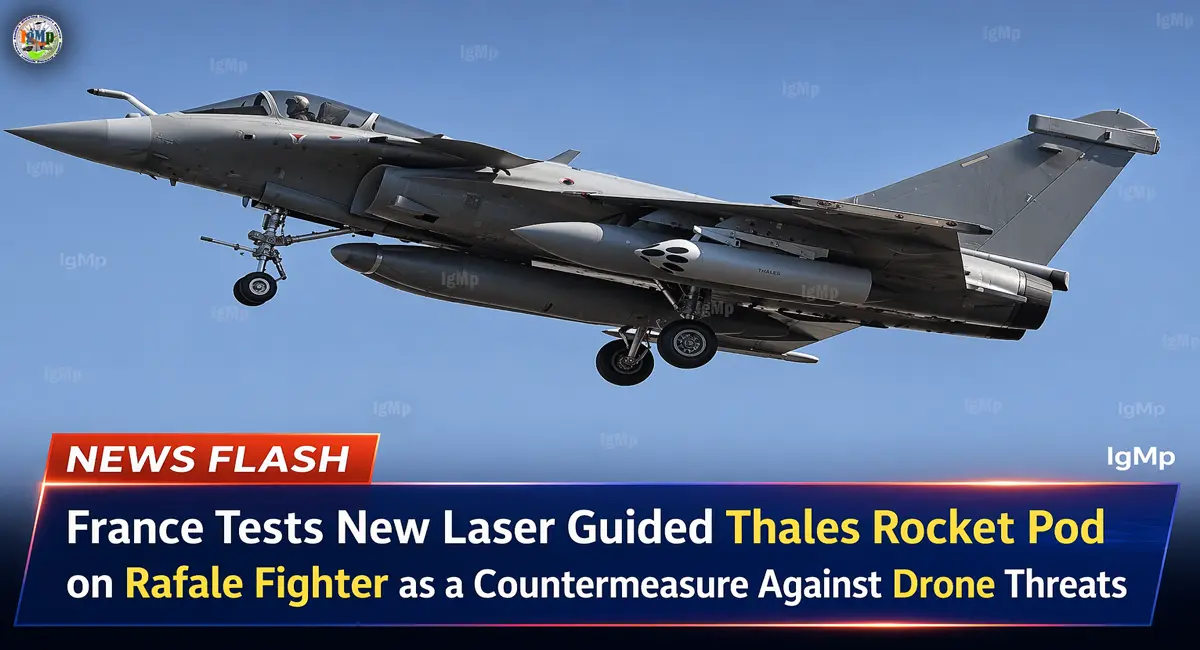
The Rafale F5 standard represents a transformative leap beyond traditional fighter upgrades. Built on the Dassault Rafale platform, it is being designed as a network-centric warfare node, capable of orchestrating multiple assets simultaneously.
Rather than functioning as a standalone aircraft, the F5 will operate within a “system of systems” architecture, integrating manned and unmanned elements into a unified combat framework.
Key technological shifts include:
- Manned-Unmanned Teaming (MUM-T):
The Rafale F5 will control and coordinate “Loyal Wingman” combat UAVs, enabling it to extend its operational reach, conduct high-risk missions remotely, and act as a battlefield commander. - Hypersonic Strike Integration:
The aircraft is expected to carry the ASN4G hypersonic missile, significantly enhancing its strategic deterrence capability and positioning it within future nuclear delivery doctrines. - Advanced Sensor Fusion and AI Integration:
Enhanced onboard processing will allow the aircraft to fuse data from multiple sources, prioritize threats, and assist pilots with real-time decision-making in complex combat environments. - Network-Centric Warfare Role:
The Rafale F5 will serve as a central node in a distributed combat network, linking satellites, drones, and ground systems into a cohesive operational picture.
This evolution signals a broader trend in air combat:
future fighters will not fight alone—they will command ecosystems.
Funding vs. Order Book: The Strategic Trade-Off
| Feature | UAE Position (Withdrawn) | India Position (Lifeline) |
|---|---|---|
| Financial Role | Direct R&D Funding (€3.5 Billion) | Commercial Order Volume ($40 Billion) |
| Key Demand | Intellectual Property (IP) Access | Local Manufacturing (MRFA) |
| Strategic Goal | “Black Box” Optronics Control | Long-term F5 Upgrade Path |
| Impact of Exit | France bears 100% R&D cost | India ensures production viability |
This comparison underscores a critical distinction in defense economics. While the UAE offered upfront funding to accelerate innovation, India provides something arguably more valuable—scale, continuity, and industrial stability.
- R&D funding reduces immediate financial burden but may introduce strategic dependencies
- Large orders ensure long-term production viability and supply chain stability
- India’s role strengthens export confidence and program longevity
- France retains full technological sovereignty despite higher upfront costs
In essence, the Rafale F5 program is transitioning from a funding-driven model to a demand-driven ecosystem.
India’s $40 Billion MRFA Deal: The Real Lifeline
India’s MRFA program has emerged as the single most important external factor shaping the Rafale F5’s future. With a projected value of $40 billion for 114 aircraft, it represents one of the largest fighter acquisition programs globally.
Although India is not directly financing F5 development, its order provides:
- Guaranteed production continuity over multiple decades
- Economies of scale that lower per-unit costs and support upgrades
- A stable industrial base for Dassault Aviation
- A pathway for incremental integration of F5 technologies into future batches
The India-Specific Enhancement (ISE) Advantage
India’s earlier acquisition of 36 Rafale jets included a comprehensive package of India-Specific Enhancements (ISE). These modifications were tailored to unique operational requirements such as high-altitude performance, advanced electronic warfare, and regional threat scenarios.
These investments now provide a critical advantage:
- They establish a customized technological baseline for future upgrades
- They reduce the complexity of integrating next-generation F5 features
- They position the Indian Air Force as a priority stakeholder in future development cycles
In practical terms, India has already contributed to the evolutionary pathway that enables the F5 standard.
Is India Subsidizing French Sovereignty?
This question reflects a growing debate in defense and policy circles. By declining UAE funding while relying on India’s large-scale procurement, France appears to be shifting financial risk without compromising control.
However, the reality is more nuanced.
From France’s perspective:
- Sovereignty over critical technologies remains non-negotiable
- Domestic funding replaces external influence, preserving strategic independence
- India’s order ensures industrial continuity without IP concessions
From India’s perspective:
- Access to cutting-edge F5 capabilities comes without direct R&D expenditure
- Participation in MUM-T and Loyal Wingman ecosystems enhances future readiness
- Alignment with France offers a diversified defense partnership beyond traditional suppliers
Rather than a subsidy, this arrangement represents a mutually beneficial strategic alignment, where both nations achieve their long-term objectives without compromising core interests.
Rafale F5 vs F4: Why This Transition Matters
The progression from the F4 to F5 standard represents a shift from enhancement to transformation.
F4 Standard Improvements:
- Upgraded radar and sensor performance
- Enhanced connectivity and data-sharing capabilities
- Improved survivability and electronic warfare systems
F5 Standard Breakthroughs:
- Full integration of drone teaming (MUM-T) capabilities
- Compatibility with hypersonic nuclear delivery systems
- Evolution into a battlefield command and control hub
For the Indian Air Force, this transition is critical. It determines not just the capability of individual aircraft, but the overall effectiveness of future air combat doctrine.
Strategic Fallout: Impact of UAE Exit on Dassault Aviation
The immediate impact of the UAE’s withdrawal is a funding gap estimated at around €5 billion, placing additional pressure on France to sustain development timelines.
However, the long-term implications are more strategic than financial:
- France reinforces its commitment to sovereign defense development
- Dependence on India’s MRFA outcome becomes more pronounced
- India’s role evolves from customer to strategic partner
For Dassault Aviation, the challenge is clear—balance short-term financial strain with long-term strategic gains.
Rafale F5 Program Destiny
The Rafale F5 program is no longer defined by the UAE’s exit—it is being reshaped by a new geopolitical equation:
- The UAE prioritized technology access and control—but walked away
- France prioritized sovereignty—even at financial cost
- India provides scale, stability, and long-term viability
In this evolving triangle, the decisive factor is no longer who funds development—but who anchors the future ecosystem. And in that equation, India’s $40 billion order stands as the most powerful lever shaping the Rafale F5’s destiny.