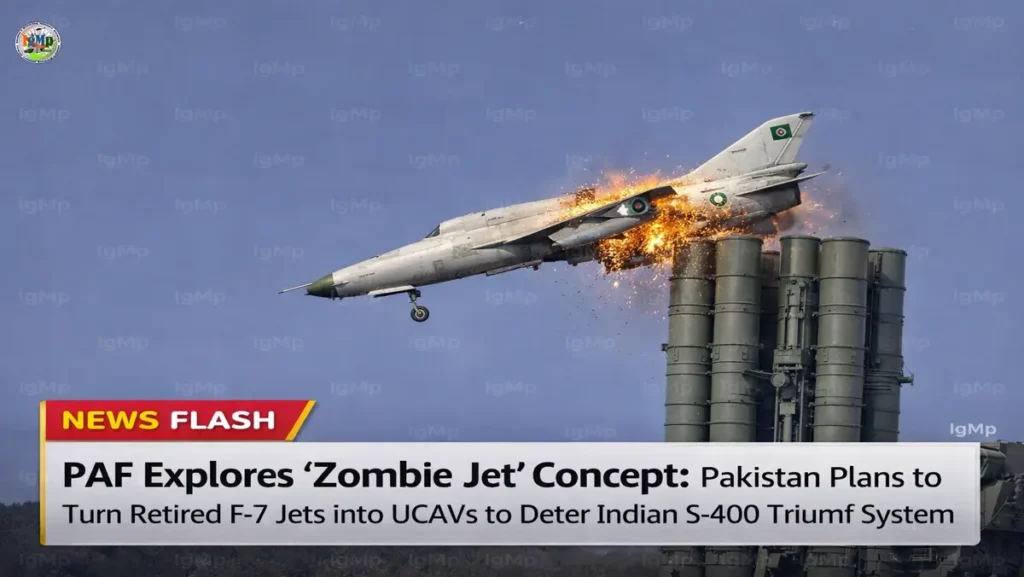
Pakistan Air Force (PAF) is developing a “Zombie Jet” concept by converting retired Chengdu F-7 fighters into unmanned combat aerial vehicles (UCAVs). These supersonic drones could act as high-speed decoys (“S-400 magnets”) or kamikaze strike platforms, potentially overwhelming advanced air defence systems like the S-400 Triumf through saturation attacks.
This concept gained traction following late 2025 satellite imagery from Mianwali Airbase, which indicated unusual clustering of retired F-7 platforms, suggesting possible modification or testing activity. The idea aligns with earlier Chinese experiments involving J-6/J-7 drone conversions, giving the concept both precedent and technical plausibility.
How does the ‘Zombie Jet’ conversion work?
The conversion process involves stripping out cockpit-dependent systems and replacing them with autonomous or remote flight control architecture. Likely contributors include Global Industrial and Defence Solutions (GIDS) and Pakistan Aeronautical Complex (PAC Kamra), both central to Pakistan’s indigenous aerospace programs.
Key modifications include:
- Integration of GPS/INS-based navigation systems
- Secure data-link for remote piloting and mission updates
- Pre-programmed strike or decoy flight profiles
To enhance survivability or deception, these drones could also be fitted with Luneberg lenses, which artificially inflate radar signatures—making the aircraft appear larger and more valuable on enemy radar screens.
The ‘S-400 Magnet’ Tactic: Using F-7s as High-Speed Decoys
One of the most critical applications of the “Zombie Jet” is as a decoy platform in saturation attacks. With a Mach 2 speed profile, the unmanned F-7 can rapidly penetrate contested airspace, forcing air defence systems like the S-400 Triumf to respond.
The logic is rooted in missile economy. Each S-400 interceptor missile can cost millions of dollars, while a retired F-7 airframe has near-zero residual value. By deploying multiple such drones simultaneously, Pakistan could attempt to:

- Trigger premature missile launches
- Deplete interceptor inventories
- Create gaps for follow-on strike aircraft
Combined with Nap-of-the-Earth (NOE) flight profiles, where drones fly at extremely low altitudes to avoid radar detection, this tactic could complicate engagement timelines for defenders.
Supersonic Kamikaze: The 9-Ton Missile Capability
Beyond decoy roles, the “Zombie Jet” concept also includes a kamikaze strike function. With the removal of pilot systems, the aircraft gains additional payload capacity, potentially allowing it to carry up to 2,000 kg of explosives or munitions.
At Mach 2 speeds, such a platform effectively becomes a high-speed guided missile, capable of striking hardened or high-value targets. Unlike subsonic drones like the Bayraktar TB2 or Shahed-136, a supersonic UCAV drastically reduces reaction time for air defence systems.
This dual-role flexibility—decoy and strike—makes the concept operationally attractive despite its risks.
📊 Strategic Comparison: F-7 vs ‘Zombie’ UCAV
| Feature | Standard F-7PG | ‘Zombie’ UCAV Variant |
|---|---|---|
| Pilot | Required | Autonomous / Remote |
| Max Speed | Mach 2.0 | Mach 2.0 (Expendable) |
| Payload | Limited by pilot systems | Up to 2,000 kg |
| Primary Role | Interceptor | Decoy / SEAD / Strike |
| Cost | High lifecycle cost | Low (Disposable Asset) |
Technical Hurdles: Jamming, Data-links, and Autonomy
Despite its potential, the “Zombie Jet” faces significant operational challenges. Maintaining reliable data-links in a contested electronic warfare environment is difficult, especially against advanced adversaries like India.
Aircraft such as the Dassault Rafale and Sukhoi Su-30MKI are equipped with sophisticated electronic warfare (EW) suites capable of jamming or spoofing drone control signals. This raises the risk of mission failure or even loss of control.

Additionally, true autonomy—where the drone can adapt mid-mission without external input—remains technologically complex and resource-intensive. Without robust AI-driven navigation and targeting, these systems may struggle in dynamic combat scenarios.
Strategic Takeaway: Innovation or Desperation?
The “Zombie Jet” concept reflects a broader shift toward asymmetric and cost-imposing warfare, where older platforms are repurposed to challenge expensive, high-end systems.
If successfully implemented, it could complicate air defence planning by introducing high-speed, expendable threats into the battlespace. However, its effectiveness will ultimately depend on execution, particularly in overcoming electronic warfare and coordination challenges.
In modern air combat, the contest is no longer just about firepower—but about forcing the enemy to spend more, react faster, and make mistakes. The “Zombie Jet” is a clear attempt to exploit exactly that.